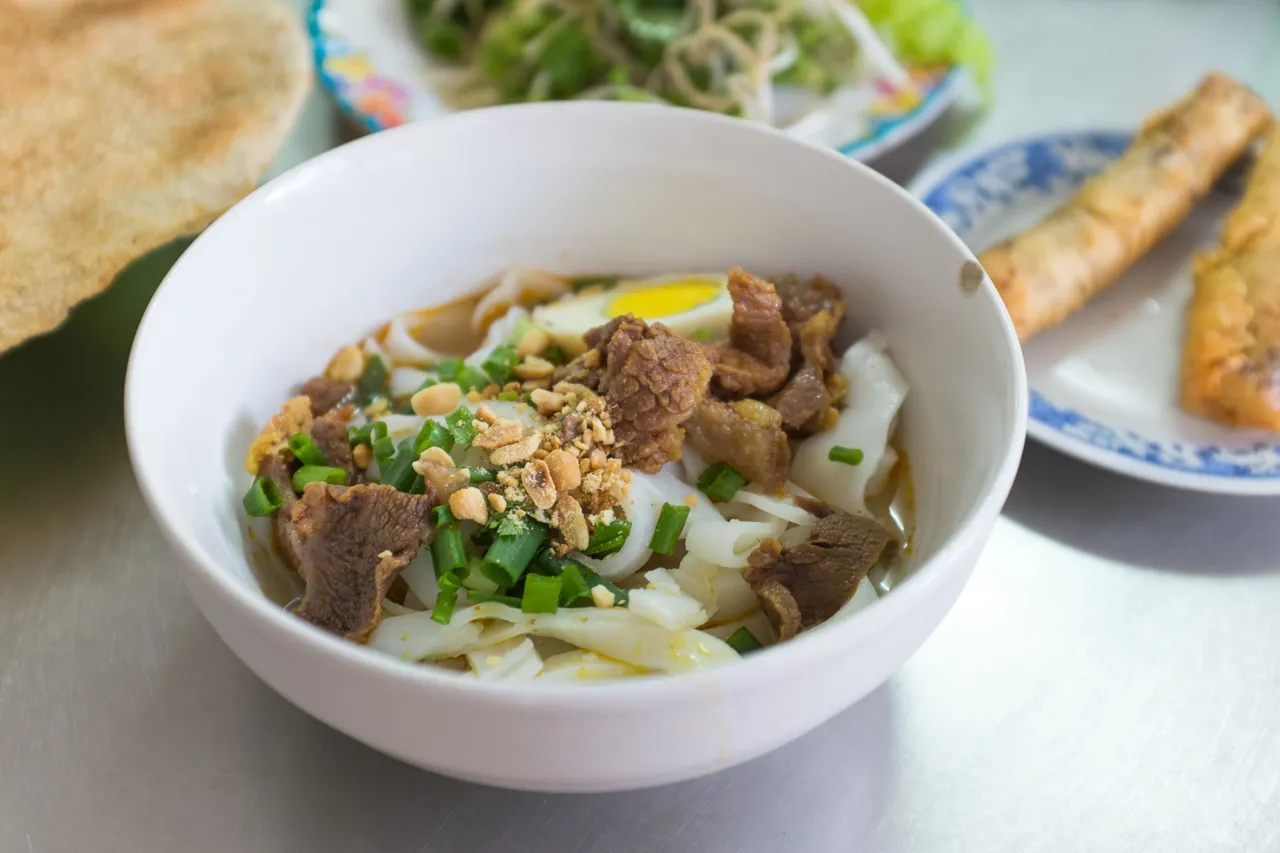
First-time home cooks learning the craft of making mì Quảng often reach for their softest jasmine rice, only to watch the steamed sheets tear and turn mushy in the bowl. Seasoned noodle makers across present-day Da Nang city do the exact opposite. They seek out firm, high-starch paddy grains, brush the sheets with shallot-infused peanut oil, and ladle just enough concentrated sauce to wet the bottom of the bowl.
In Episode 2, join Bánh Mì Xin Chào on a dawn visit to traditional craft villages and home kitchens to uncover the secrets behind that structure.
From ancient folk verses on prized rice grains to white, yellow, and red brown-rice mì Quảng strands
The first secret of resilient mì Quảng strands lies in the paddy field. While everyday steamed rice prizes softness, noodle sheets require a firmer Indica grain rich in amylose so the ribbons stay pleasantly chewy when tossed with hot sauce [9].
According to research in Van Hoa Newspaper, drawing on ancient Sa Huynh and Champa wet-rice traditions, generations of Quang Nam villagers distilled the four best local rice varieties for noodle making into a folk verse [9]:
Ba Trang, Xuyet grain, and Tri rice,
Add Can paddy too, and the noodles taste finer still.
After 1980, as older heirloom varieties grew scarce, farmers introduced the 13/2 (IR17494) rice variety, whose firm, high-starch character proved so close to traditional noodle grains that locals affectionately called it gao Xuyet (or gao xiet) after the classic grain [9]. A report by Da Nang Newspaper in Ke Xuyen village (formerly Binh Trung commune in Thang Binh district, now part of expanded Da Nang city) notes that local families have grown 13/2 rice across four generations specifically for traditional noodle workshops in neighboring Duy Xuyen, where ten kilograms of soaked and stone-ground grain yield roughly 120 sturdy noodle sheets [1].
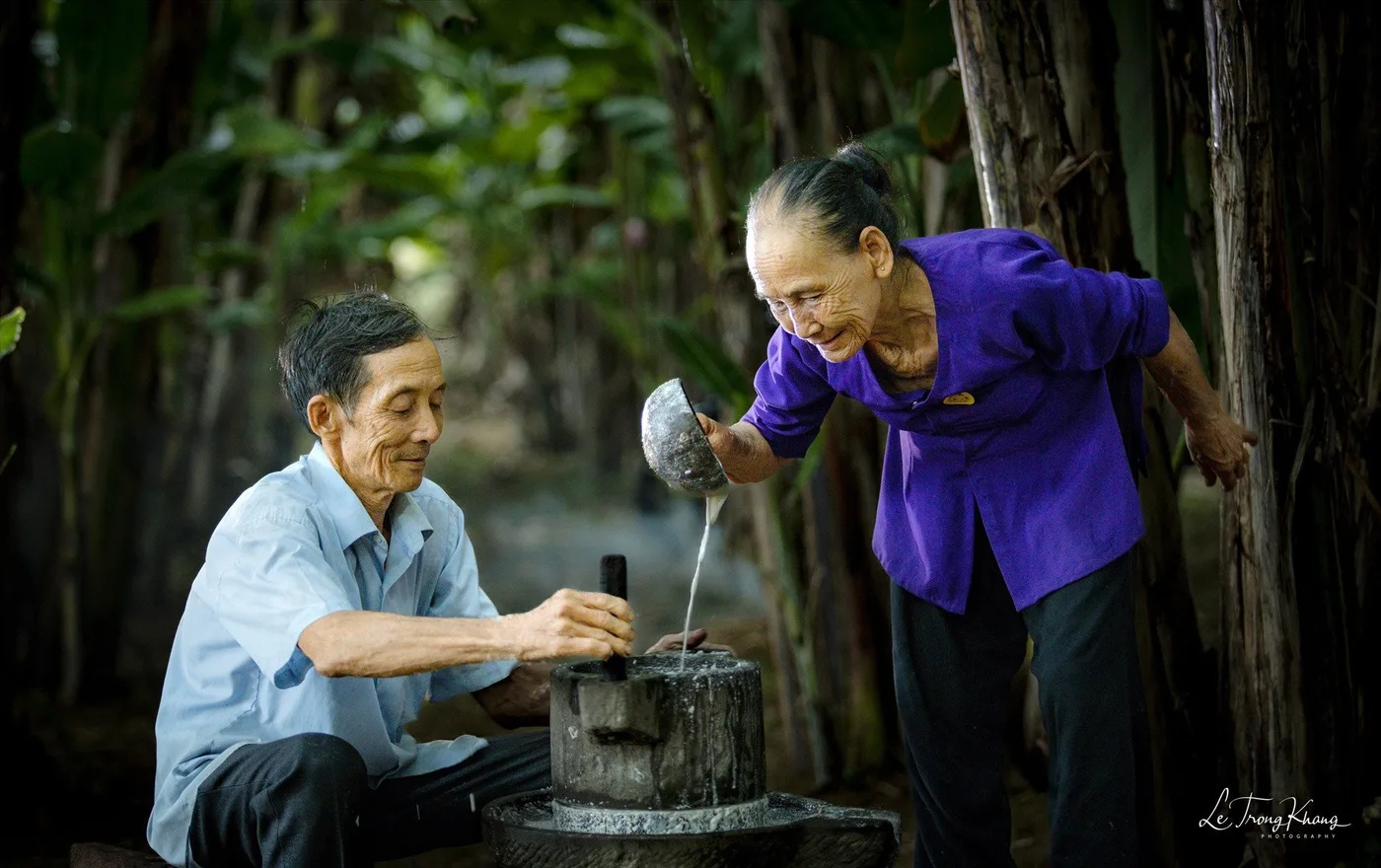
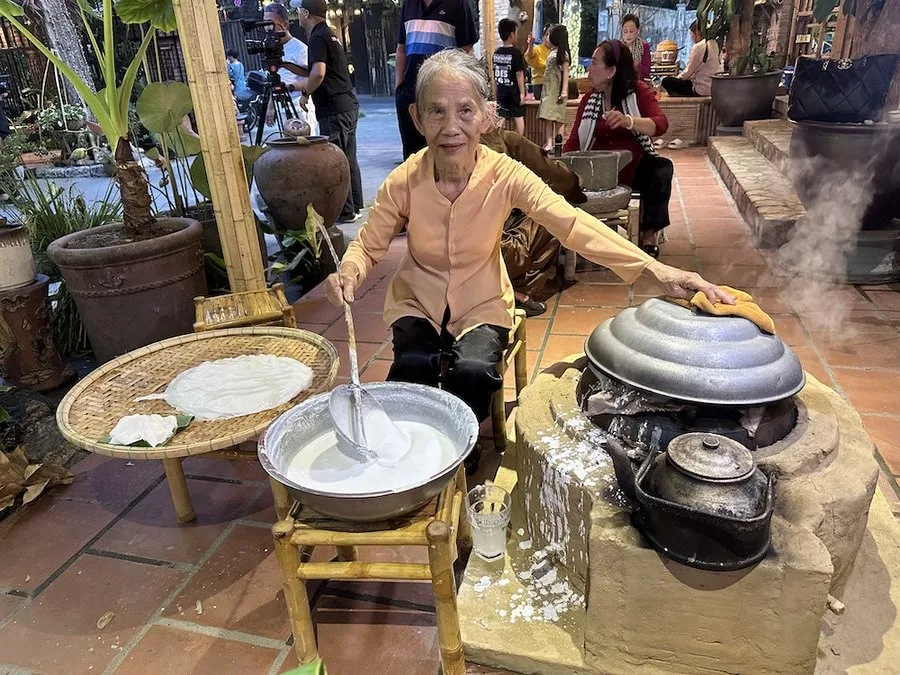
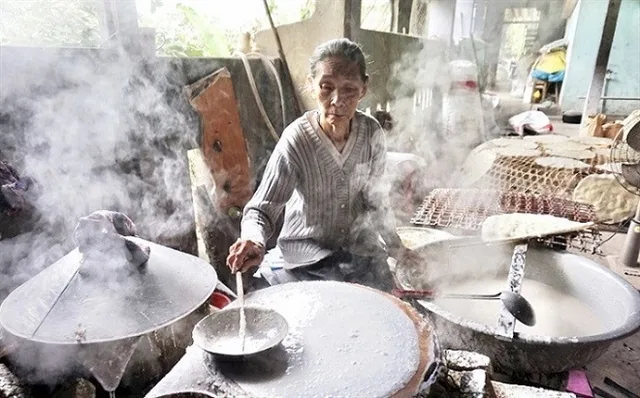
In riverside Phu Chiem village (now in Dien Ban ward, Da Nang city), work begins the afternoon before with washing, soaking the rice for three to four hours, and wet-milling it on a stone mill [2] [10]. Around two or three in the morning, rice-husk fires bring wide pots of water to a rolling boil beneath taut cloth frames [2].
Artisans ladle thin circles of batter, cover the lid briefly until steam turns the sheet translucent, lift it with a flat bamboo blade, fan it cool, and brush the surface with tempered peanut oil so stacked layers never stick together before slicing them by hand into ribbons about one centimeter wide [2] [6].
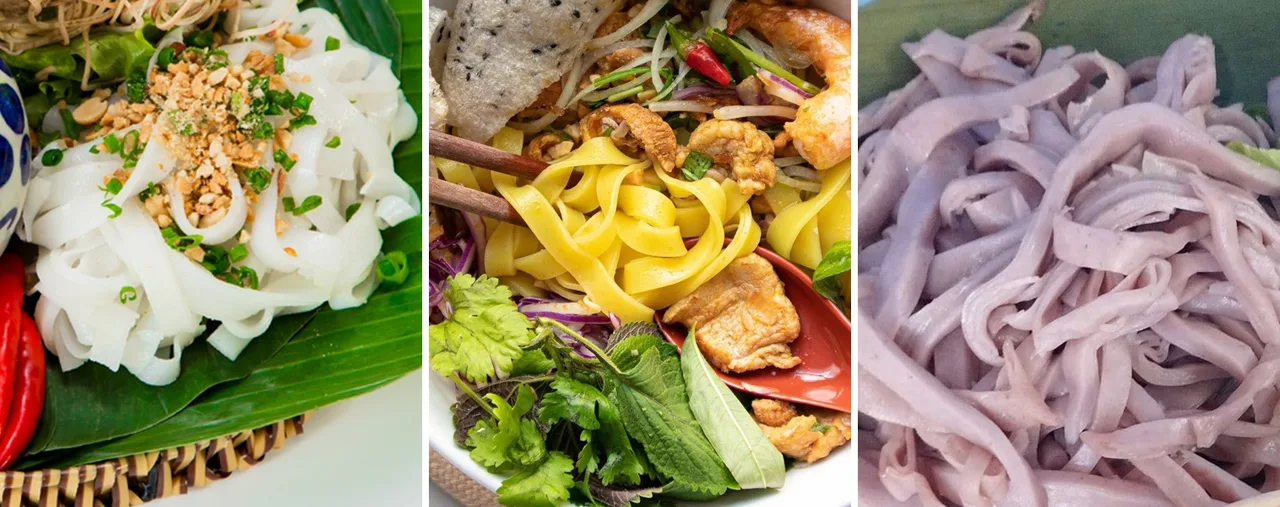
Right at this batter-mixing and steaming stage, attentive diners traveling across Da Nang's villages and city streets today will notice three distinct noodle hues existing side by side: ivory-white strands, golden-yellow strands, and reddish-brown whole-grain rice strands:
- Ivory-white strands: This is the original, unadulterated color of pure stone-ground rice flour in ancient riverside craft villages such as Phu Chiem (Dien Ban ward) and Trung Phu (Go Noi commune) [10] [11]. Steamed solely from wet rice batter and clear well water, these thin ivory ribbons preserve the delicate aroma of fresh grain and act like a white silk canvas ready to absorb the vibrant colors of the nuoc nhun sauce when tossed [10] [11].
- Golden-yellow strands: Widely loved across stalls in Hoi An, Tam Ky, and central Da Nang. As culinary artisan Nguyen Quoc Nghi explained in VnExpress, makers blend fresh turmeric juice (or gardenia seed extract) into the rice batter before steaming, or brush turmeric-infused peanut oil onto the warm sheet to give the strands a sunny golden hue [11]. Beyond visual warmth, turmeric imparts a subtle herbal note that mellows any raw starch scent and pairs naturally with braised chicken, frog, or snakehead fish [11].
- Red brown-rice strands: Rooted in the rural memory of hand-pounded unpolished rice and indigenous red-bran varieties such as lua loc do and the heirloom lua Can praised in the old folk verse [9]. Reporting by Thanh Nien Newspaper and Da Nang Newspaper notes that family workshops along the Vu Gia River (such as Vu Gia commune in former Dai Loc, now part of Da Nang city) soak and stone-grind unpolished red brown rice (gao lut do) or lua Can grain into naturally reddish-brown noodle sheets [12] [13]. Without a drop of artificial coloring, the intact bran layer lends a rustic terracotta hue, a nutty depth of flavor, and wholesome dietary fiber cherished by both heritage-minded locals and modern health-conscious diners [12] [13].
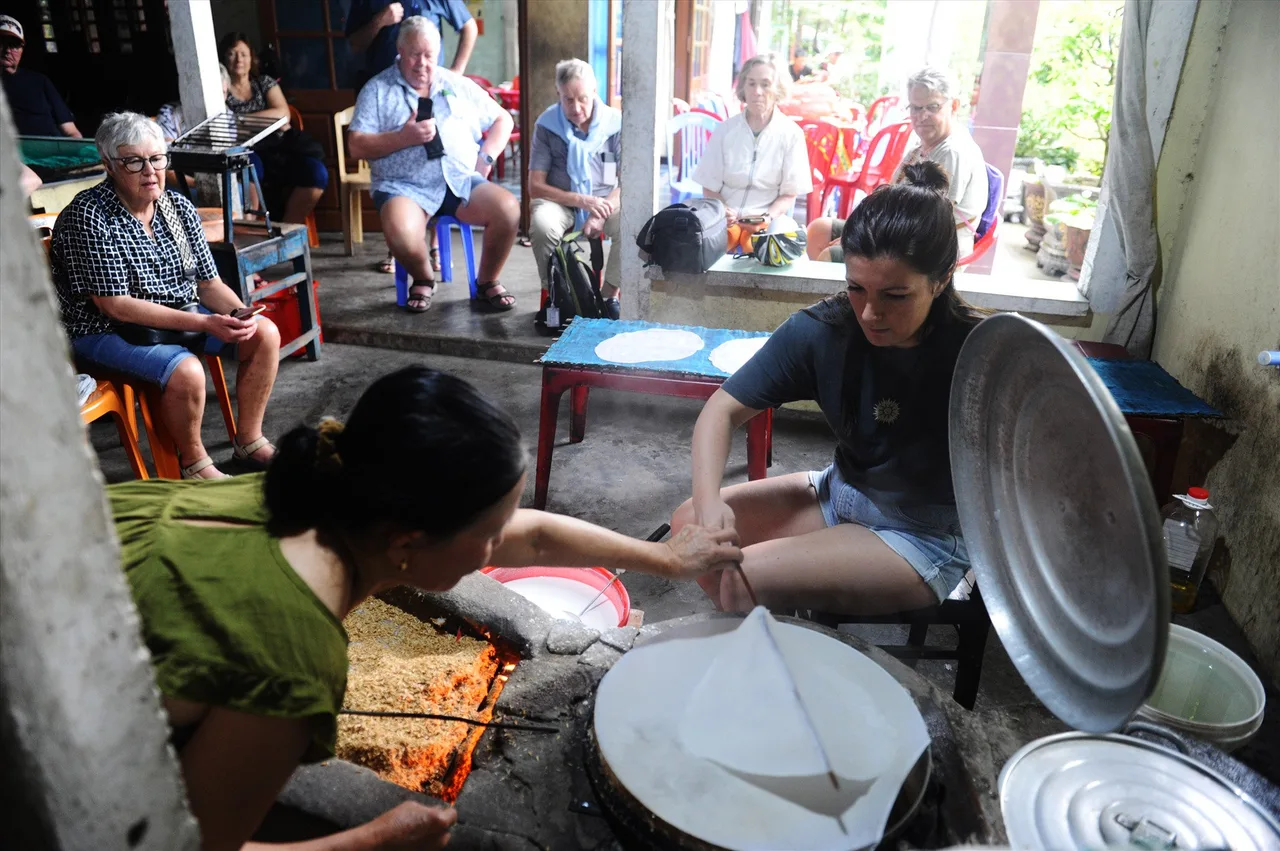
Just across the Thu Bon River in Ha My hamlet (formerly Duy Vinh commune, now part of Nam Phuoc commune in Da Nang city), Mrs. Vo Thi An has kept her 20-year-old rice-husk stove glowing every day to welcome three to five groups of European travelers who cycle down a narrow two-meter village lane into her cozy 20-seat kitchen [8]. What captivates these foreign guests is not only turning the stone mill or lifting warm noodle sheets by hand, but also the zero-waste circle of rural rice farming: the white grain becomes noodle ribbons, the rice husk fuels a fragrant fire beneath the steamer pot, and the cooled husk ash returns to the garden as organic fertilizer for the herbs and peanuts served alongside the bowl [8].
White shallots in hot peanut oil and the story of savory sauce from village stalls to family kitchens
Step from the steamer into a central Vietnamese kitchen and your nose greets two unmistakable scents: artisanal pressed peanut oil and crushed cu nen, tiny pearl-white wild shallots grown in coastal sandy soil. Dropped into hot peanut oil, cu nen sizzles until a warm, pungent aroma fills the room [4] [5].
The late writer Vu Duc Sao Bien once coined a playful classical maxim to describe that fragrance:
Without pressed peanut oil, there is no true soul of mì Quảng [6].
That fragrant oil both glosses freshly steamed noodle sheets and sears marinated river shrimp, pork belly, or free-range chicken before stock is added and simmered down into a savory nuoc nhun sauce [4] [6].
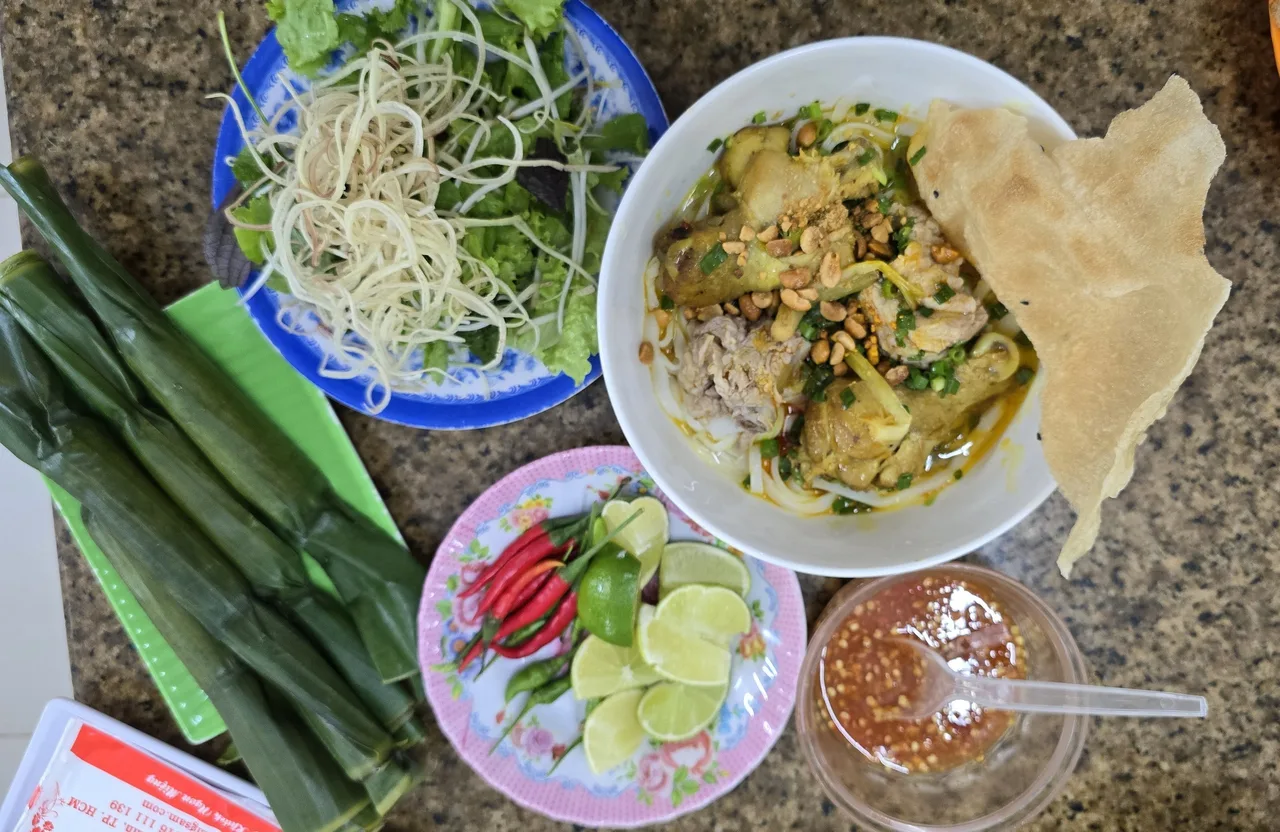
When it comes to how much sauce goes into the bowl, everyday life in Quang Nam holds an endearing nuance. In many family kitchens, mothers cooking a big pot of mì Quảng on a rainy day often ladle extra, fuller broth to please family members who enjoy sipping hot soup. Even in Phu Chiem village, field reporting by Da Nang Newspaper observed that while veteran artisans ladle thick sauce barely a third of the way up the bowl, other village stalls ladle more generous broth to suit regular diners [7].
Even with those warm household variations, the defining hallmark of classic mì Quảng remains concentrated nuoc nhun (nhun set) ladled shallowly so it barely wets the bottom of the bowl. Because the reduction packs the sweetness of shrimp and meat with nutty peanut oil, tossing the strands coats every ribbon without drowning the bowl like pho [6]. At Bánh Mì Xin Chào in Japan, our kitchens stay true to this classic standard, ladling a modest portion of thick, richly seasoned sauce in every bowl.
Five centuries of Tuy Loan rice crackers dried over glowing charcoal
To contrast the silky noodles and thick sauce, hometown bowls are traditionally paired with crisp black-sesame rice crackers broken by hand over the top [6]. Across central Vietnam, few names are as beloved as the 500-year-old Tuy Loan rice-paper village (formerly Hoa Phong commune in Hoa Vang district, now Hoa Vang commune in Da Nang city) [3].
According to craft records in Da Nang Newspaper, Tuy Loan artisans use that same firm 13/2 grain (known locally as gao xiet), washed in village well water and ground into settled starch, then seasoned with hulled sesame seeds, savory Nam O fish sauce, sugar, salt, and crushed ginger and garlic [3].
Two artisanal techniques give Tuy Loan crackers their signature crunch:
- Double-layered steaming on cloth: Just as the first thin layer sets, the maker reads the rising steam and pours a second coat directly atop the first, forming a sturdy 40 to 50 centimeter disc.
- Drying on bamboo cages over charcoal instead of sunlight: Fresh sheets rest across woven bamboo cages warmed from below by ash-covered charcoal embers for three to five hours, then toast over glowing coals before serving until they blister golden and release the scent of sesame, ginger, garlic, and Nam O fish sauce [3].
Yet chewy noodles and savory sauce are only half the picture. In Episode 3, we explore how golden turmeric, red annatto oil, a generous basket of fresh greens, and fiery Da Nang chili sauce complete the soul of mì Quảng.
References
- Báo Đà Nẵng (2012, September 18). Làng chuyên sản xuất gạo tráng mỳ Quảng. Báo Đà Nẵng.https://baodanang.vn/lang-chuyen-san-xuat-gao-trang-my-quang-3017541.html
- Hoàng Đạo (2015, June 14). Di sản của người bán mỳ. Báo Đà Nẵng.https://baodanang.vn/di-san-cua-nguoi-ban-my-3051550.html
- Báo Đà Nẵng (2023, December 15). Để tạo những chiếc Bánh tráng Túy Loan, người làm bánh đã thực hiện những công đoạn rất công phu và chuyên nghiệp. Báo Đà Nẵng.https://baodanang.vn/de-tao-nhung-chiec-banh-trang-tuy-loan-nguoi-lam-banh-da-thuc-hien-nhung-cong-doan-rat-cong-phu-va-chuyen-nghiep-3293579.html
- Báo Đà Nẵng (2010, August 22). Gia vị của người Quảng. Báo Đà Nẵng.https://baodanang.vn/gia-vi-cua-nguoi-quang-3000061.html
- Thanh Niên (2016, October 12). Gia vị củ nén của người Quảng. Báo Thanh Niên.https://thanhnien.vn/gia-vi-cu-nen-cua-nguoi-quang-185222549.htm
- Vũ Đức Sao Biển (2014, April 8). Triết lý mì Quảng - Kỳ 1: Để ăn mì Quảng đúng bài. Báo Đà Nẵng.https://baodanang.vn/triet-ly-mi-quang-ky-1-de-an-mi-quang-dung-bai-3029441.html
- Báo Đà Nẵng (2022, October 8). [eMagazine] - Mỳ Quảng, từ Phú Chiêm nghĩ tới… Phú Quốc. Báo Đà Nẵng.https://baodanang.vn/emagazine-my-quang-tu-phu-chiem-nghi-toi-phu-quoc-3043585.html
- Phạm Hải (2023, March 6). Lan tỏa câu chuyện mỳ Quảng ra thế giới. Báo Đà Nẵng.https://baodanang.vn/lan-toa-cau-chuyen-my-quang-ra-the-gioi-3042849.html
- Thụy Bất Nhi (2024, October 2). Đi tìm giá trị nguyên gốc của Mỳ Quảng. Báo Văn Hóa.https://baovanhoa.vn/di-tim-gia-tri-nguyen-goc-cua-my-quang-107056.html
- Cục Di sản Văn hóa (2024, August 9). Di sản văn hóa phi vật thể Mỳ Quảng.https://dsvh.gov.vn/my-quang-22259
- Tuấn Đào (2025, July 21). Mì Quảng - món 400 năm mang đậm tình quê. VnExpress.https://vnexpress.net/mi-quang-mon-400-nam-mang-dam-tinh-que-4915556.html
- Hoàng Liên (2026, March 30). Mỳ Quảng - bản giao hưởng của ký ức và di sản. Báo Đà Nẵng.https://baodanang.vn/my-quang-ban-giao-huong-cua-ky-uc-va-di-san-3330467.html
- Ngọc Thanh (2016, December 8). Tìm ăn mì Quảng 'đúng Quảng' ở Sài Gòn. Báo Thanh Niên.https://thanhnien.vn/tim-an-mi-quang-dung-quang-o-sai-gon-185613956.htm